
Updated daily:21st October, 2026
Today Chicken Rate in India: Live, Broiler & 1 Kg Prices
Check today’s chicken rate across India, including live, broiler, boneless, and skinless chicken prices. Compare rates across major cities and explore daily market data to understand the price of chicken per kg.
Today’s chicken rate in India
Updated daily:21st October, 2026|
Boneless Chicken |
₹370.00 |
|
Live Chicken |
₹208.00 |
|
Skinless Chicken |
₹263.20 |
|
Chicken Liver |
₹185.60 |
Check today’s chicken rate in India, including live broiler, boneless, and skinless chicken prices. Explore the latest price per kg and compare rates across cities to understand the different chicken prices reported in local markets.
1 kg Chicken Rate today in India by City and Chicken Type
Explore today’s chicken rate list for major Indian cities, with prices organized by chicken type. Compare the listed rates per kg for boneless, live, skinless chicken, and chicken liver wherever data is available.
| City | Boneless Chicken (₹) | Live Chicken (₹) | Skinless Chicken (₹) | Chicken Liver (₹) |
|---|---|---|---|---|
| Delhi | ₹520.00 | ₹240.00 | ₹280.00 | ₹240.00 |
| Mumbai | ₹460.00 | ₹250.00 | ₹300.00 | ₹200.00 |
| Kolkata | ₹400.00 | ₹200.00 | ₹240.00 | ₹220.00 |
| Chennai | ₹420.00 | ₹210.00 | ₹280.00 | ₹190.00 |
| Ahmedabad | ₹400.00 | ₹220.00 | ₹280.00 | ₹180.00 |
| Bangalore | ₹450.00 | ₹240.00 | ₹300.00 | ₹170.00 |
| Barwala | ₹210.00 | ₹130.00 | ₹200.00 | ₹120.00 |
| Nagpur | ₹460.00 | ₹250.00 | ₹300.00 | ₹200.00 |
| Raipur | ₹210.00 | ₹130.00 | ₹200.00 | ₹120.00 |
| Indore | ₹380.00 | ₹220.00 | ₹260.00 | ₹240.00 |
| Mysore | ₹450.00 | ₹240.00 | ₹300.00 | ₹170.00 |
| Bhopal | ₹380.00 | ₹220.00 | ₹260.00 | ₹240.00 |
| Pune | ₹460.00 | ₹250.00 | ₹300.00 | ₹200.00 |
| Hyderabad | ₹440.00 | ₹220.00 | ₹280.00 | ₹180.00 |
| Patna | ₹210.00 | ₹130.00 | ₹200.00 | ₹120.00 |
| Ranchi | ₹210.00 | ₹130.00 | ₹200.00 | ₹120.00 |
| Surat | ₹400.00 | ₹220.00 | ₹280.00 | ₹180.00 |
| Lucknow | ₹320.00 | ₹230.00 | ₹270.00 | ₹220.00 |
| Varanasi | ₹320.00 | ₹230.00 | ₹270.00 | ₹220.00 |
| Ludhiana | ₹210.00 | ₹130.00 | ₹200.00 | ₹120.00 |
| Kanpur | ₹320.00 | ₹230.00 | ₹270.00 | ₹220.00 |
| Vijayawada | ₹440.00 | ₹220.00 | ₹280.00 | ₹180.00 |
| Agra | ₹320.00 | ₹230.00 | ₹270.00 | ₹220.00 |
| Namakkal | ₹420.00 | ₹210.00 | ₹280.00 | ₹190.00 |
| Visakhapatnam | ₹440.00 | ₹220.00 | ₹280.00 | ₹180.00 |
Compare Today’s Broiler and Live Chicken Rates by City
Compare today’s broiler and live chicken rates across the cities covered by our data. Select the available price category to see how rates differ by location and identify variations between local markets.
National Market Overview: Live, Boneless, skinless & Highest/Lowest Cities
Review today’s chicken market rates across the tracked categories. Where reliable data is available, compare retail, wholesale, and farm-level prices to understand which types of market quotations are being reported.
Chicken Rate Today and Price Trends Over Time
Explore how chicken prices have changed over time with the interactive price trend chart. Choose a city, chicken category, and time period to review historical rates and see whether prices have risen, fallen, or remained stable.
How Chicken Prices Are Determined in India
From Poultry Farm to the Consumer
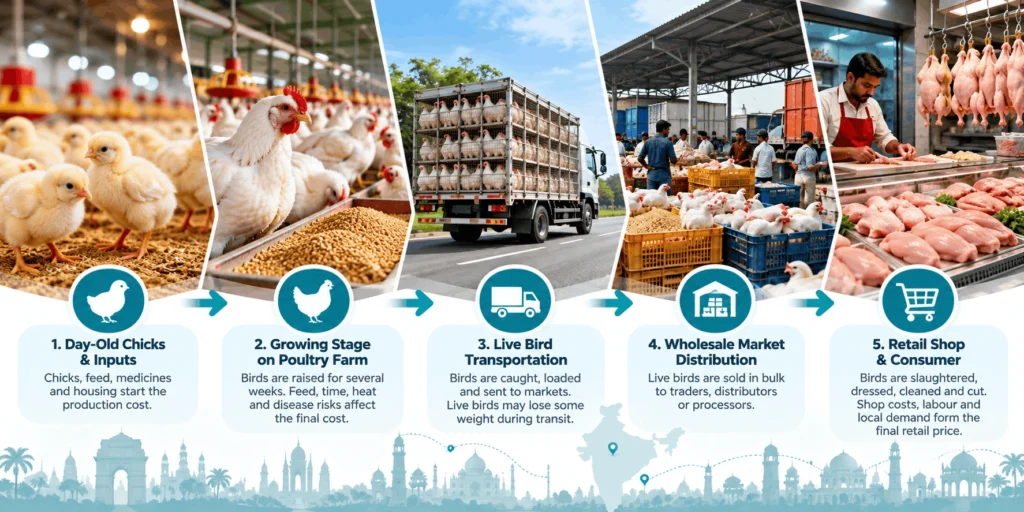
Most chicken starts as a day old chick placed on a broiler farm. The birds are raised for several weeks, caught, loaded and sent onward live. A Tamil Nadu poultry society leader said in 2024 that birds should reach about 2 kg in around 40 days normally. They then go either to a market stall or shop, where they are slaughtered and dressed to order, or to a processing plant that sells dressed, chilled or cut chicken.
Research on contract farming describes one common arrangement. A company supplies chicks, feed and medicines, the farmer provides housing and labour for a growing charge, and the company arranges sale of the grown birds, mostly through traders. Farmers outside a contract buy their own inputs and sell at the market price.
Older trade reporting described India’s broiler sector as almost completely a live bird market, with only a small share sold processed. That may have changed since.
Each stage adds handling and cost. The Food and Agriculture Organization notes that live birds commonly lose one to three percent of their weight between farm and market. So a quotation depends on the stage at which the chicken is sold.
Factors That Influence Broiler Chicken Prices
Feed
A 2022 report quoting an industry body official put feed at about 65 percent of production cost. Feed is mostly grains such as maize, plus oilseed meals such as soybean. This is one source, and the share can vary.
Chicks and time
A bird takes weeks to grow, so chick placements today decide supply some weeks later
Heat
A 2015 report put normal summer mortality at 2 to 3 percent, rising to about 10 percent in a heat wave. A 2024 report quoted a former veterinary university director saying heat can add 7 to 8 days to the time birds need to reach ideal weight.
Disease and demand
After bird flu reports in several states in January 2021, chicken demand reportedly fell by close to 30 percent and broiler prices dropped within a week. A scare can lower prices as well as raise them.
Local costs
Transport, distribution and local demand add to what a shop pays, and their effect differs by market.
Why Chicken Prices Differ Between States and Markets
Four things can explain the gap, though none applies equally everywhere:
So two rates are comparable only when they cover the same product, unit and stage.
Live, Broiler, Skinless and Boneless Chicken: What’s the Difference?
Live Chicken vs Dressed Chicken
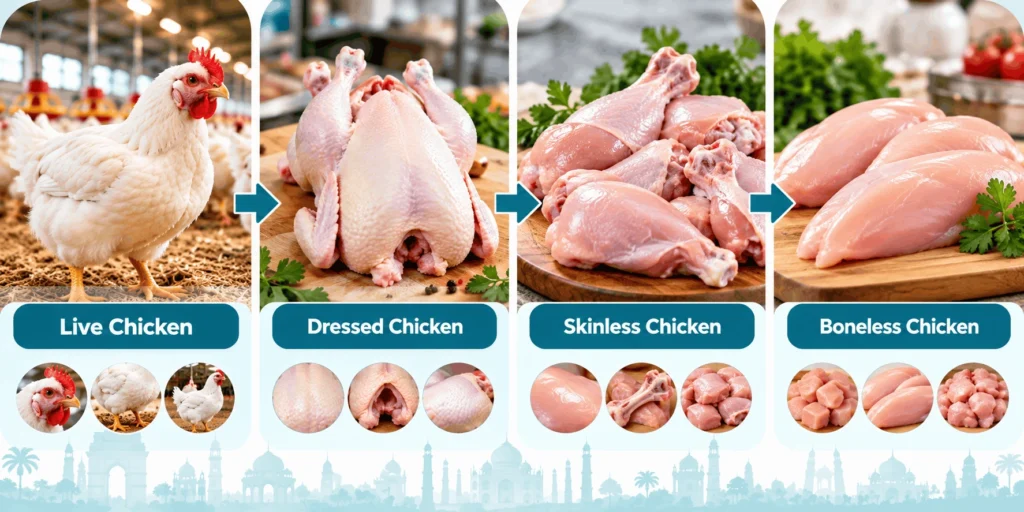
Live weight is the weight of the whole living bird, including feathers, blood and intestines. Dressing removes these and anything else the seller does not sell, so dressed chicken weighs less than the bird it came from. How much less depends on the bird and on trimming. No single reliable yield figure applies everywhere, so none is given here.
A live bird means paying for weight you will not take home. Dressed chicken means paying for work already done. A live rate and a dressed rate per kilogram are not directly comparable unless you know which weight each uses.
Skinless Chicken vs Bone-In Chicken
These are two separate steps. Skinless chicken has had its skin removed, and it may still have bones. Bone in cuts keep the bone, and boneless meat has had it taken out.
Skin removal adds labour and takes away some of the weight sold. No fixed premium for skinless chicken is documented, so none is claimed. Check that both quotes match on skin, bones, cut and cleaning.
Boneless Chicken vs Bone-In Chicken
Boneless chicken is meat with the bones removed.
Deboning takes labour and leaves less saleable weight from the same bird, which can raise the price per kilogram. A lower price per kilogram does not guarantee the same amount of usable meat. Compare by the meat you need, not only the rate.
What Does Broiler Chicken Mean?
Broiler chicken is poultry raised mainly for meat. The word describes the bird’s purpose, not the form it is sold in. A broiler can be sold live, dressed, skinless or boneless. So “broiler” says what the bird is for, while “live”, “skinless” and “boneless” say how it is prepared. A quotation naming only one leaves the rest unstated.
What Does Chicken Paper Rate Mean in India?
Understanding the Term “Chicken Paper Rate”
No official or industry body definition has been found in government livestock sources,
agricultural university material or poultry association publications.
The term does appear on commercial rate sites. One daily rate service offers a “chicken paper
rate” through alerts without defining it, and uses terms such as mandi rate and bazaar bhav
beside it without explaining how they differ. Other rate sites say a paper rate is a daily price
printed in newspapers or circulated by poultry companies. These are claims from commercial
sources.
So the meaning is not settled nationwide. It may refer to a circulated reference quotation in one market and something different in another. Confirm what it covers.
Chicken Paper Rate vs Live-Bird and Retail Quotations
A paper rate cannot be assumed to be the wholesale rate, the live bird rate or a shop price.
What matters is what each quotation states: product, weight basis, stage, place and date.
A retail price also covers dressing, transport, rent and labour, and may be for a different
product such as skinless chicken. Not every quotation refers to live broilers, and not every
paper rate is a wholesale rate.
How to Interpret a Chicken Rate List
Read five things before trusting any list:
If any is unclear, check it before comparing lists.
Farm, Wholesale and Retail Chicken Prices
Explained
How Farm-Level Chicken Sales Work
A farmer raises the birds and sells them live. A farm gate sale happens at the farm, before transport and later stages add cost. Costs include feed, chicks, labour, housing and bird health.
Contract farmers are paid a growing charge, while others take the market price. The farm figure covers the bird at the farm only.
How Wholesale Chicken Distribution Works
Wholesale means selling in bulk to buyers who resell. Depending on the market, buyers can be traders, distributors, processors or retailers. Research on contract farming names traders as buyers from integrators, but not every chain has the same intermediaries.
Bulk buyers deal in order size, transport and handling, unlike a household buying one kilogram. A wholesale quotation is not a shop price.
How Retail Chicken Prices Are Formed
A retail price covers the chicken plus what the seller does to it and what it costs to run the shop. That can include:
Two sellers can price differently without their margins being known.
Why Farm, Wholesale and Retail Rates Are Not Directly Comparable
Each rate describes a different transaction. A farm rate is for a live bird at the farm, a wholesale rate is for bulk buyers, and a retail rate is for a consumer and may include services. They also differ in product, weight basis and inclusions.
Before comparing two quotations, check this list:
- Same product: live, dressed, skinless or boneless
- Same unit: per kilogram or per bird
- Same stage: farm, wholesale or retail
- Same date and market
- Same inclusions: cleaning, cutting, delivery
A hypothetical example, not a market rate: if Seller A quotes 100 for cleaned chicken and Seller B quotes 90 plus a separate 15 for cleaning, Seller A costs less overall. Only the final cost for the same product and quantity shows that.
Today Chicken Rate by City: Check Local Prices Across India
Looking for the chicken rate in a particular city? Choose your city below to check local chicken prices, explore historical rates, and learn more about the factors that can affect prices in that market.