
Today Chicken Rate in Mumbai
Updated daily:14th October, 2026 · Source: Mumbai Government
Boneless Chicken Rate
₹210.00 /kg
Broiler Chicken Live Rate
₹130.00 /kg
Skinless Chicken Rate
₹200.00 /kg
Chicken Liver
₹120.00 /kg
The latest chicken rate in Mumbai includes four useful price points: ₹210.00/Kg for boneless chicken, ₹130.00/Kg for live broiler chicken, ₹200.00 for skinless chicken and ₹120.00/Kg for chicken liver. Checking all four together gives a broader view of today’s chicken prices in Mumbai.
Last Month Price Trend
Chicken rate in Mumbai: What the Recent Data Shows
Recent figures can tell you more than the current Mumbai chicken rate alone. This section compares the highest and lowest retail prices with the average rate for the selected period. The trend chart below provides another way to follow the daily changes in chicken prices.
Highest Retail Rate
₹130.00 14 Oct
Lowest Retail Rate
₹130.00 14 Oct
Average Retail Rate
₹130.00
Last Month Breakdown
Chicken Rate in Mumbai During the Last Month
To put today’s Mumbai chicken rate into perspective, the table below takes you through the previous month’s daily prices. Comparing these records can help you spot the range of prices and understand how the rate changed throughout the month.
| Date | Boneless (₹) | Live (₹) | Skinless (₹) | Liver (₹) |
|---|---|---|---|---|
| 14 Oct 2026 | ₹210.00 | ₹130.00 | ₹200.00 | ₹120.00 |
| 26 Sep 2026 | ₹280.00 | ₹175.00 | ₹220.00 | ₹165.00 |
What Factors Affect Chicken Prices in Mumbai?
Mumbai is a crowded island city with little room for large poultry farms. Its birds travel in from farms across Maharashtra. Trade listings show suppliers in districts such as Palghar, Thane and Raigad, and further inland around Pune and Nashik. So the Mumbai chicken rate often follows events that happen far from the city.
Poultry Supply and Availability
Farm output depends on decisions made weeks earlier. A broiler takes about five to six weeks to grow, so chicks placed today decide how many birds reach Mumbai later. Hot weather can slow growth and thin out supply for a while.
A 2017 Business Standard report showed this clearly. High temperatures had reduced the meat reaching markets. Once the weather cooled, birds gained weight and supply recovered. That is one past example, not a description of the present.
Feed and Production Costs
Feed is the largest cost on a poultry farm. A 2017 report quoting industry executives put it at about two thirds of production costs. Maize and soybean meal make up most of it.
Chicks, labour, electricity, vaccines and farm upkeep add to the bill. Farmers pass these costs on to the next buyer, and each later step adds its own.
The same 2017 report also shows that cost is not the whole story. Feed was cheap that year, yet the average broiler price in Mumbai rose sharply because demand grew.
Consumer and Food Service Demand
Households in Mumbai tend to buy small amounts often. Restaurants, hotels, caterers and food stalls buy in larger lots, so a busy week for them can tighten supply for everyone.
Household demand is more sensitive to price. Food businesses may keep buying at a higher rate because their menus depend on chicken. That difference can keep the chicken price in Mumbai firmer than farm conditions alone would suggest.
Transportation and Distribution
Birds usually arrive by road, and often alive. Fuel, tolls, loading and waiting time all become part of the cost. Mumbai’s traffic can add delay, and delay can mean weight loss and bird deaths on the way.
Once chicken is in the city, it has to reach shops spread across the island and the suburbs. Each extra handover adds a small cost, and those costs show up in the retail price.
Seasonal Demand
Many households avoid meat during Shravan, and demand can dip. The 2017 Business Standard report listed it as normally a low consumption month. Ganeshotsav, Navratri and other festival periods may also change buying habits, depending on the household.
Weddings, family gatherings and Eid season can lift demand for some sellers. Heavy monsoon rain may reduce footfall and delay deliveries. None of these effects is automatic. Supply decides how far demand moves the price.
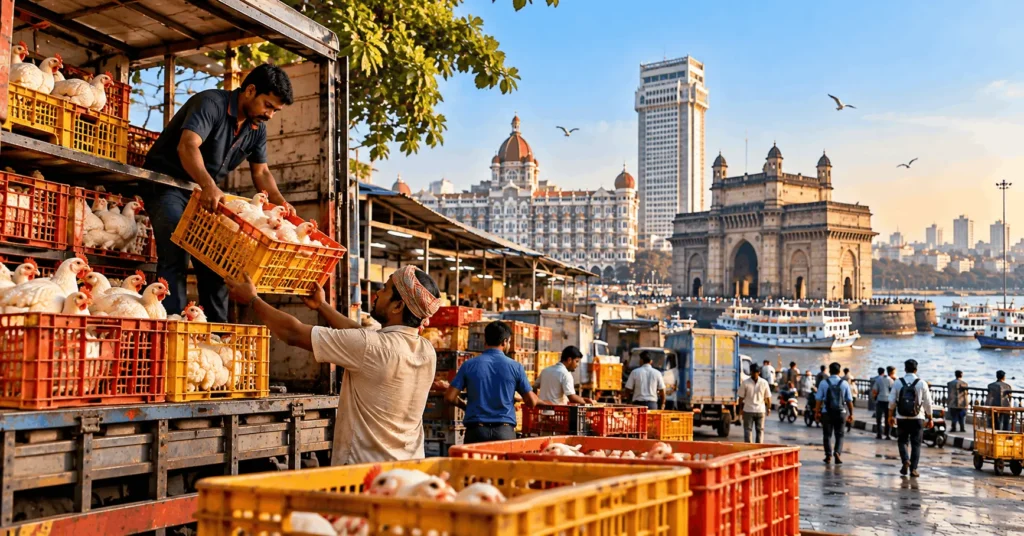
Why Chicken Prices Differ Between Mumbai Markets
Wholesale and Retail Pricing
A wholesale rate is for birds sold in bulk, usually live. A retail chicken price has to cover more: dressing, transport to the shop, rent, electricity, ice or refrigeration, labour, wastage and the seller’s margin.
A bird also loses weight once feathers, skin and offal are removed. The shop sells less meat than it bought.
Local Market Conditions
Shop rent and footfall differ a lot across Mumbai. A busy market with many chicken shops in Mumbai may keep prices tight because buyers can walk to the next stall. A shop in a quiet lane with few rivals may price differently.
Supply also matters. A shop that buys early in the day may pay a different rate from one that restocks later. Sellers set prices based on what they paid, what they expect to sell and what the shop costs to run.
Cleaning and Processing Costs
Cleaning, cutting, skinning and boning all take labour. Each step also reduces the weight left to sell. That is why skinless and boneless chicken costs more per kilogram than a whole bird.
A quoted rate may be for a live bird, a dressed bird or ready cut meat. These are different products, so the numbers are not directly comparable.
Supermarkets and Online Sellers
Supermarkets and online sellers add packaging, cold storage, handling and delivery. Platform fees and minimum orders can also shape the final bill. Their prices are often higher than a local shop, though offers can narrow the gap. Convenience is part of what you pay for.
How to Choose Chicken at a Good Price in Mumbai
Compare the same chicken type
Match whole with whole, curry cut with curry cut and boneless with boneless. A lower number on a different product tells you little.
Check what is included in the price
Ask whether cleaning, cutting, packaging or delivery cost extra. A small charge can turn a cheaper looking quote into the more expensive one.
Consider usable meat
The lowest rate per kg is not always the lowest cost. Chicken with bone and skin gives less edible meat than boneless. Compare what ends up in the pan, not only what goes on the scale.
Compare more than one seller
Check two or three nearby sellers on the same day, ideally for the same cut. Even a short walk can show how much prices vary between sellers.
Don’t Ignore Freshness and Quality
Look for clean handling, a tidy counter and proper cold storage. Fresh meat should smell clean and look moist. A few rupees saved are not worth poor hygiene.
Mumbai’s Chicken Supply Chain From Farm to Consumer
Poultry Farms and Production
Farms across Maharashtra raise the birds. Reports on the state’s poultry sector describe large integrated companies, including firms based in Pune, that manage chicks, feed and farming under one system. Smaller farms supply the market as well.
Wholesale Distribution
From the farm, birds pass through traders, agents and distributors. Some chicken is sold live and some is dressed before it reaches the retailer. This research did not find reliable evidence of one single market that supplies all of Mumbai, so the article does not claim one.
Local Retailers and Food Businesses
Chicken shops, restaurants, hotels, caterers and canteens handle the last step. Shops sell to households. Food businesses buy for their kitchens, often in bulk and on a regular schedule.
Factors That Increase the Final Retail Cost
The cost builds up at every stage:
- Transport and fuel between farm, wholesaler and shop
- Labour for catching, dressing, cutting and selling
- Processing, including cleaning, skinning and boning
- Storage, ice and refrigeration
- Packaging for supermarkets and online orders
- Shop rent, electricity and other running costs
Browse Chicken Rates by City
Explore chicken rates across major Indian cities to compare local prices and find the latest rates for your city. Select a city below to check its chicken prices, recent trends, and price history.
QUESTIONS