
Today Chicken Rate Bangalore
Updated daily:14th October, 2026 · Source: Bangalore Government
Today live chicken rate in Bangalore is:
Boneless Chicken Rate
₹210.00 /kg
Broiler Chicken Live Rate
₹130.00 /kg
Skinless Chicken Rate
₹200.00 /kg
Chicken Liver
₹120.00 /kg
For shoppers checking today chicken rate Bangalore, the latest price figures are ₹210.00/Kg for boneless chicken and ₹130.00/Kg for live broiler chicken. Skinless chicken is currently ₹200.00, while chicken liver is ₹120.00/Kg. Together, these four figures show the latest prices available on this page.
Last Month Price Trend
Today Chicken Rate Bangalore: From Today’s Price to the Recent Trend
Today chicken rate in Bangalore becomes easier to understand when it is compared with recent data. Here you can see the period’s highest and lowest retail prices alongside the average rate. The price chart then shows how the rate changed across the selected days.
Highest Retail Rate
₹130.00 14 Oct
Lowest Retail Rate
₹130.00 14 Oct
Average Retail Rate
₹130.00
Last Month Breakdown
A Month of Bangalore Chicken Rate Changes
The last 30 days can reveal price changes that are not obvious from today’s figure alone. The table below lists the recorded Bangalore chicken rate for each day of the previous month, giving you a simple way to compare daily prices across the period.
| Date | Boneless (₹) | Live (₹) | Skinless (₹) | Liver (₹) |
|---|---|---|---|---|
| 14 Oct 2026 | ₹210.00 | ₹130.00 | ₹200.00 | ₹120.00 |
| 26 Sep 2026 | ₹280.00 | ₹175.00 | ₹220.00 | ₹165.00 |
How Chicken Reaches Bengaluru’s Consumers: From Supply Points to Retail
Poultry Sourcing for Bengaluru’s Market
Karnataka has an organised poultry sector. Its apex body, the Karnataka Poultry Farmers and Breeders Association (set up in 1991), publishes farm gate price points for towns across the state, including Bangalore, Tumkur and Kolar. That points to poultry distribution in Karnataka spread over many towns.
Public sources do not say how much of Bengaluru’s chicken comes from any one district, or where a given shop buys, so it is safer not to assume. Nearby sourcing also does not settle price or quality. What reaches you depends on how the bird was handled after slaughter.
What Happens Between Slaughter, Processing, and Retail?
FSSAI’s poultry guidance describes the usual stages. Birds are slaughtered and dressed, and in a processing plant carcasses should be chilled to 4 degrees Celsius or below within four hours. The meat may then be cut, deboned, packed and dispatched. Retail poultry meat is expected to come from an FSSAI approved slaughterhouse, though a butchery cum retail shop may slaughter on site.
At the counter this looks like three routes: live birds weighed alive and slaughtered to order, freshly dressed chicken sold the same day, or packaged chicken sold chilled or frozen with a label. Sellers do not all follow the same chain.
How Bengaluru’s Traffic & Delivery Logistics Can Affect Distribution
Moving a perishable product through a congested city is a planning problem. A 2025 TomTom index put the average drive for 10 km in Bengaluru at about 36 minutes. A 2024 Bengaluru Traffic Police notification also barred heavy goods vehicles from the city at set hours, 7 am to 11 am and 4 pm to 10 pm on most days. Such rules can change, and nothing public says which vehicles carry chicken, so this is only an example.
Delay matters most for temperature. FSSAI’s guidance notes that transport refrigeration mainly maintains temperature and does not pull heat out of warm product. A late vehicle is a handling concern first. No evidence shows that traffic raises chicken prices in Bengaluru.
Why Consistent Supply Requires Coordination
Each stage depends on the one before it, and FSSAI’s guidance asks businesses to assign batch codes so products can be traced back through the chain.
Here is a hypothetical example, not a real incident. A distributor’s morning round runs two hours late. The first shops open without stock, and shops at the end of the route get a smaller share. Many can cover the gap from their fridge or another supplier, so a delay does not always mean a shortage.
Chicken Cold Chain in Bengaluru: Why Temperature Control Matters
Why Chicken Needs Careful Temperature Control
Raw chicken spoils quickly and can carry bacteria that cause food poisoning. Bacteria multiply faster as it warms, so time spent warm matters as much as the temperature.
FSSAI’s guidance sets the chicken cold chain at 4 degrees Celsius or below for chilled product and minus 18 degrees Celsius or below for frozen, through storage, transport and retail. Fresh poultry for immediate sale over the counter is an exception. Smell and look cannot settle safety, because harmful bacteria do not always change either.
Chilled and Frozen Chicken: What Is the Difference?
Chilled chicken is kept cold but not frozen. It has a shorter life and suits cooking soon. Frozen chicken keeps longer, but only while it stays frozen.
Neither is always fresher or safer, and freezing does not repair poor handling beforehand. Follow the pack’s directions for storage, thawing and whether it can be refrozen.
What to Check on Packaged Chicken
FSSAI’s guidance says packaged poultry must carry a label that allows safe storage and display, and batch tracing in a recall. Look for:
Check that the pack is sealed and the shop’s fridge or freezer is running. A label shows what the seller declares, not how the pack was handled on the way.
Safe Transport From Shop to Home
Take raw chicken straight home to the fridge or freezer. Carry it in its own leak proof bag, away from food eaten without cooking.
At home, store it below ready to eat food, wash hands, knives and boards after handling it, and thaw in the fridge unless the pack says otherwise. Cook until hot all the way through. FSSAI’s guidance treats a core temperature of at least 75 degrees Celsius as cooked.
Freshly Dressed, Chilled, Frozen, and Marinated Chicken: What Are You Buying?
Freshly Dressed Chicken and Refrigerated Chicken
Freshly dressed chicken is slaughtered, dressed and sold at the counter soon after. Refrigerated chicken is chilled after processing and held at 4 degrees Celsius or below.
“Fresh” is a weak guide. FSSAI’s guidance does not define it and uses temperatures instead, so the word says nothing about hours since slaughter or how clean the handling was. A freshly dressed bird kept warm for hours is not safer than chilled chicken held correctly. Ask about time out of the cold, and about hygiene.
Whole Chicken, Curry Cut, and Boneless Portions
Whole chicken includes skin, bones and parts you may not use. Curry cut is the bird cut into pieces, still on the bone. Boneless portions are muscle meat only.
Each step adds labour and removes weight, so a kilogram of bone in chicken gives less cookable meat than a kilogram of boneless. Bones do add flavour, so compare by the meat your recipe needs, not price per kilogram alone.
Marinated and Ready-to-Cook Chicken
Marinated chicken is seasoned raw chicken, and ready to cook packs add portioning and packaging. That costs money, so the price is not comparable with plain chicken, and part of the pack weight may be marinade.
Read the label. FSSAI’s guidance treats semi cooked products, heated between 60 and 75 degrees Celsius, as needing reheating above 75 degrees Celsius, and expects the label to say so.
Choosing the Right Product for Your Intended Use
Start with the dish. Curry cut suits curry, boneless suits skewers or a stir fry, and a whole bird suits roasting. Then consider your kitchen: chilled chicken is for cooking soon, frozen for later if you have freezer space.
When comparing two products, match the cut, skin on or off, raw or marinated, chilled or frozen, and pack size. A different product at a lower listed price is not a saving.
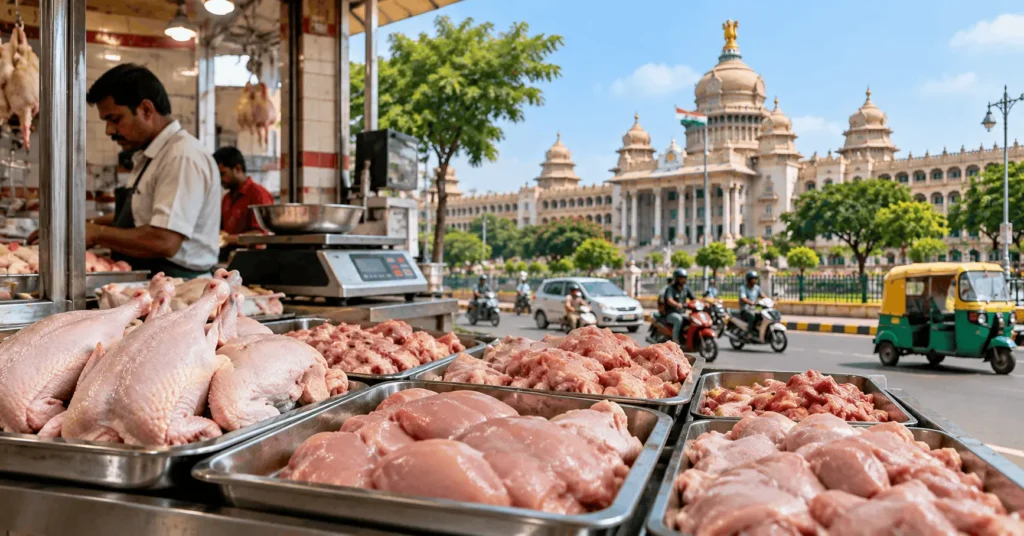
How to Assess a Reliable Chicken Seller in Bengaluru
Signs of Good Hygiene at a Chicken Shop
FSSAI’s guidance for retail meat outlets gives checks you can see:
A tidy shop is a good sign, not proof. Cold storage and sourcing are harder to see.
What Food Licences and Product Information Can Tell You
India uses a three tier system: registration, State licence and Central licence. The smallest operators, called petty food businesses, register. FSSAI describes them by annual turnover up to Rs 12 lakh and/or capacity limits, which for slaughter include 50 poultry birds a day or less. Which tier applies depends on a seller’s type and size, so do not assume all sellers have the same obligations.
An FSSAI licence number has 14 digits starting with 1, and a registration number has 14 digits starting with 2. Check it with FSSAI’s Food Safety Connect app or the FoSCoS FBO search. A licence shows a business is on record. It does not guarantee every product is safe at every moment.
Questions to Ask Before Buying
- Is it live, freshly dressed, chilled, frozen or marinated? This decides storage and how soon to cook.
- Is the weight taken before or after preparation? Skin, bones and trimming change what you take home.
- Are cleaning and cutting included? Some sellers charge separately.
- If packaged, what do the storage instructions and dates say? They tell you how cold, and for how long.
- How should I carry and store it? A counter seller can say how soon to use it.
What to Do When Product Quality Is in Doubt
Avoid chicken in torn, leaking or swollen packs, past its date, or stored warm when it should be cold. Smell and look are not reliable tests.
To raise a concern, keep the pack, label and receipt, note when you bought it, tell the seller, and do not eat the chicken. If it is not resolved, FSSAI offers a 24×7 toll free helpline on 1800112100, and its online system Food Safety Connect accepts consumer concerns about food.
Browse Chicken Rates by City
Explore chicken rates across major Indian cities and compare the latest prices with previous market data. Select a city below to view its chicken rates and understand how prices have changed over time.
QUESTIONS