
Today Chicken Rate Hyderabad
Updated daily:14th October, 2026 · Source: Hyderabad Government
Boneless Chicken Rate
₹210.00 /kg
Broiler Chicken Live Rate
₹130.00 /kg
Skinless Chicken Rate
₹200.00 /kg
Chicken Liver
₹120.00 /kg
Here is the latest price snapshot for any one looking for today chicken rate Hyderabad. Boneless chicken is listed at ₹210.00/Kg, while live broiler chicken is ₹130.00/Kg. The current skinless chicken price is ₹200.00 and chicken liver is ₹120.00/Kg. You can compare these figures with the recent trend below.
Last Month Price Trend
Today Chicken Rate Hyderabad: Price Range and Trend
Recent price data helps put the current Hyderabad chicken rate into context. The summary below identifies the highest, lowest and average retail rates recorded during the selected period. A historical chart follows these figures so you can see the rate’s movement from day to day.
Highest Retail Rate
₹130.00 14 Oct
Lowest Retail Rate
₹130.00 14 Oct
Average Retail Rate
₹130.00
Last Month Breakdown
Hyderabad Chicken Rate History for the Previous Month
Looking beyond today’s Hyderabad chicken rate, the previous month’s records show how prices behaved over a longer period. Check the daily table below to compare each recorded rate and see where the month’s higher and lower prices occurred.
| Date | Boneless (₹) | Live (₹) | Skinless (₹) | Liver (₹) |
|---|---|---|---|---|
| 14 Oct 2026 | ₹210.00 | ₹130.00 | ₹200.00 | ₹120.00 |
| 26 Sep 2026 | ₹280.00 | ₹175.00 | ₹220.00 | ₹165.00 |
How Telangana’s Poultry Industry Supplies Hyderabad
Poultry Farms Around Hyderabad
Telangana is one of India’s larger poultry states. A 2015 industry report counted more than 10,000 poultry farms in the state, holding about 70 million birds. That figure includes layers as well as broilers, and it is old, so treat it as scale rather than a current count. Business directories today list poultry and egg companies in Hyderabad and in the districts of Ranariddh, Medak and Nalgonda.
That shows farms and suppliers exist close to the city. It does not show what share of Hyderabad’s chicken comes from them. Some supply may also arrive from outside the state.
The route is fairly simple. A farm sells a flock when the birds reach market weight. Traders or integrator companies collect them, and the birds move live to dressing units and shops. Shorter distances can mean less transit loss. But a farm near the city does not guarantee a lower price at your shop, because the retail price also carries dressing, rent, labour and margin.
The Role of Hatcheries and Poultry Feed Suppliers
Hatcheries supply day old chicks, and a broiler takes about five to six weeks to reach market weight. So the number of chicks placed today decides how many birds are ready weeks from now. Supply is shaped by decisions made well before the bird reaches a shop. Chick placement today decides birds available weeks from now:
Week 0
Chicks placed
Week 1 to 5
Feed: maize and soybean meal
Week 5 to 6
Birds reach market weight
After sale
Dressing, shops, kitchens
Feed then becomes the main cost. Maize supplies energy and soybean meal supplies protein. A 2017 report quoting industry executives put feed at about two thirds of production costs.
A scientist at ICAR’s poultry research directorate in Hyderabad told a trade publication in 2015 that most Indian farmers mix their own feed from ingredients such as maize and soya. That ties feed costs closely to grain prices. In that same year, Telangana breeders reported feed prices rising by about half in twelve months after drought hit maize output. That was a past episode, not a current price.
When feed gets dearer, farmers may place fewer chicks or sell birds earlier. The effect reaches shops later, and it is not automatic. Demand and other supply also shape the final rate.
The Cost of Keeping Broiler Chickens Cool
Chickens have no sweat glands. They pant, and above roughly 30 degrees Celsius they eat less and drink two to four times more water. Poultry research links this to lower body weight, lower carcass weight and higher deaths.
Cooling has a cost. Farms use fans for ventilation, evaporative cooling pads, foggers and roof sprinklers. Foggers and cooling pads can lower shed temperature by several degrees, according to poultry industry guidance. Drinking water should stay cool and clean, since it helps birds lose heat.
All of this needs electricity and water. Reports from earlier dry summers describe borewells running dry on farms in Telangana, and water supply has been named as a constraint in the state. A Siasat report on a past price rise noted that larger farms use air coolers and other precautions, while smaller farms may stay away from rearing in peak summer.
How Weather Can Affect Chicken Availability
Heat can slow growth, so birds reach the market lighter. Some die, and farmers may place fewer chicks the next cycle. Hot journeys add transit losses too.
The 2015 heatwave is a clear past case. Temperatures reached 49 degrees Celsius in Telangana and Andhra Pradesh. Mortality was estimated at about 10 percent, against a usual summer figure near 3 percent. More recently, Telangana Today reported in August 2026 that farmers blamed heavy summer bird losses, along with higher feed costs, for tighter supply. One farmer said heat stress killed nearly 2,000 birds in every 10,000. That is one farmer’s account, not official data.
A possible supply effect is not the same as a confirmed price change. The outcome depends on how severe and how long the heat lasts, how many farms are hit, and what stock and demand look like at the time. A short hot spell may do little. Not every summer produces a shortage.
Why Live, Freshly Dressed, and Processed Chicken Are Priced Differently in Hyderabad
Live Broiler Chicken and Dressed Chicken
A live bird is weighed with its feathers, blood, head, feet and gut contents. Dressing removes all of these. What reaches the counter weighs less than the bird that was bought.
Yield varies with the size of the bird, whether skin, head or feet are kept, and how the shop trims. So no single percentage applies everywhere, and a shop’s own description of what it sells matters more. Poultry research also notes that heat stressed birds can end up with lower carcass weight.
Comparing a live rate with a dressed rate needs care. The live rate is not the price of meat. A shop has to recover the lost weight, the labour of slaughter and dressing, water and waste handling. A live rate that looks lower can still mean a higher cost per kilogram of meat.
Whole Chicken, Curry Cut, Skinless, and Boneless Options
Live bird
Sold on live weight
Whole dressed
Bones and skin
Curry cut
Cut into pieces
Skinless
Skin removed
Boneless
Muscle meat only
A whole dressed bird includes bones and skin. Curry cut is the same bird cut into pieces. Skinless chicken has the skin taken off. Boneless is muscle meat only.
Each step removes weight and adds labour. That is why boneless costs more per kilogram than whole chicken. It is also why the lowest rate does not always give the lowest cost for the meat your household uses. Take a family that needs boneless meat for a curry. Buying bone in chicken and removing the bones at home leaves less usable meat than the weight bought, though the bones can go into stock. The fair comparison is cost per kilogram of the part you actually eat.
Traditional Chicken Shops and Packaged Products
A traditional shop usually cuts and weighs to order, often from birds dressed the same day. Packaged chicken is portioned, labelled and stored in advance. It needs packaging material, chilled or frozen storage and sometimes home delivery, and these add cost. In return, buyers get convenience and consistent portions.
Neither format is always cheaper or dearer. Prices depend on the preparation, the cut, the pack size and the service included. Compare the same cut with the same preparation and the same delivery terms before drawing a conclusion.
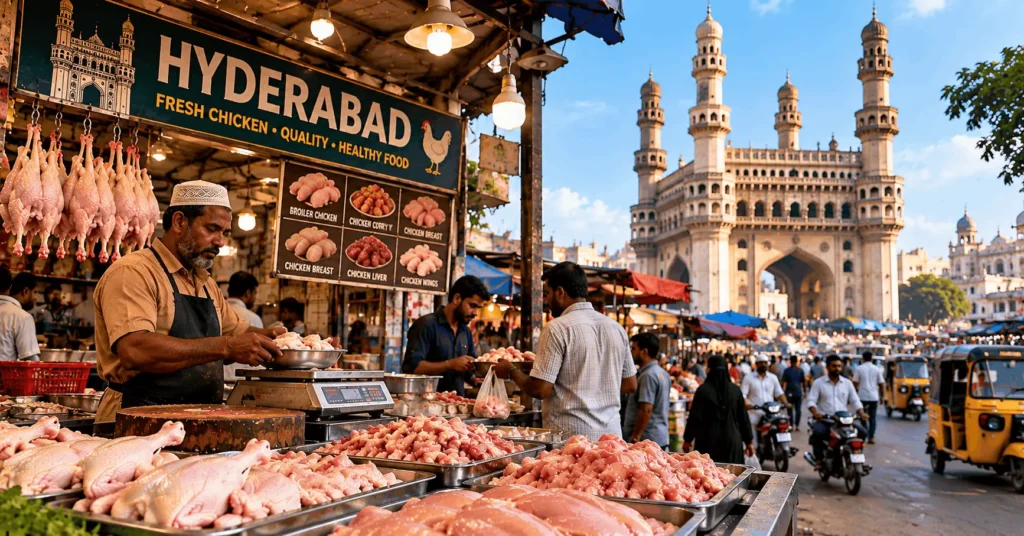
How Hyderabad’s Restaurants and Food Businesses Influence Chicken Demand
Demand From Restaurants and Biryani Businesses
Hyderabad is known for its restaurants, biryani outlets and wedding catering, and these buyers add demand on top of household cooking. No reliable figure shows what share of the city’s chicken they take, so this article gives none.
Their needs differ from a household’s. A household buys what it needs that day and can switch cuts or skip a day if prices jump. A commercial kitchen needs the same cut and piece size every day so dishes look and taste consistent and portion costs stay predictable. It also needs delivery by a fixed hour.
That makes commercial buyers less flexible when supply tightens. A Siasat report on an earlier price rise noted that caterers raised their own rates in response.
Bulk Purchasing and Supply Arrangements
Larger kitchens often order regularly from the same supplier. The aim is to secure supply and agree the cut, the cleaning standard and the delivery time. Order size, delivery frequency and processing needs all shape such arrangements.
Volume can reduce handling cost per kilogram for the supplier. But bulk buying does not guarantee a lower price. The day’s bird availability still counts, custom cuts add processing cost, and a buyer who needs fixed quantities on fixed days may pay more when stock is tight.
When Demand and Supply Fall Out of Balance
Picture a busy wedding week that arrives just after a hot spell has left fewer birds ready for sale. Orders rise while available stock falls. Buyers compete for limited supply, and the pressure is short term.
A feed cost rise works differently. It builds slowly through a rearing cycle, and farmers may respond by placing fewer chicks. That is a longer term change in production costs, not a sudden squeeze.
The pressure can also run the other way. If many households cut back on meat during a month of fasting while farms still hold ready birds, supply can exceed orders. A transport interruption or a processing limit can create a third kind of imbalance, even when bird numbers are fine.
The same pressure does not always produce the same result. Stock on hand, how long the pressure lasts and whether other regions fill the gap all change the outcome. Telangana Today’s August 2026 report is a reminder that heat losses, feed costs and export demand can arrive together, which makes any single cause hard to isolate.
Browse Chicken Rates by City
QUESTIONS